
In short
- A client pays for the years behind the 10 minutes: the nights stuck, the things broken and fixed, and the habit of saying “let’s figure this out”.
- AI makes stronger what is already there. Context, hours of conversation and experience change the answer.
- The master is a student who tried more times, and that only happens if you are ok with looking like a beginner.
One of my clients is moving her website off Wix with me, but not yet. She has two events running there, with the payments, the cancellation policy, the ticket page and the list of who’s coming all set up, and moving in the middle of that would mean two lists, two ways to pay and a few confused people. So the new site waits until the events are done.
In the meantime she pays me a small monthly fee to look after the technical side: her professional email, her newsletter, a cancellation that doesn’t fit the usual rules. For me most of it is three clicks: copy something here, open another link, paste, confirm. For her, a screen that says “add this DNS record” is a seven‑headed monster.
What a client pays for
When a client pays me for something I fix in 10 minutes, what they’re really paying for is the years it took me to get to those 10 minutes. Ten years of code before I learned design, branding and copywriting, the nights stuck on one problem for days, the things I broke and fixed, and the habit of saying “ok, let’s figure this out” when something new shows up, like a cancellation the platform wasn’t built for.
I don’t think the person who builds your website can just be a pair of hands anymore. The clients who stay with me want someone in the same boat, who takes care of their business like a partner, and sometimes that means being their advisor more than their designer.
AI makes stronger what is already there
This is much easier to do today with AI, and it doesn’t mean anyone can do it, or that my clients should do it themselves. Their focus is holding circles, running festivals, making cacao, and my focus is this.
If they ask ChatGPT why their site is slow, they get a generic answer that could be about any website (I wrote about following that kind of advice in the post about Wix). What changes the answer is context, and context takes time: hours of conversation with the client, getting into the shoes of the person who will open their site, and years of knowing how things work behind the scenes.
If I asked AI how to become the best painter of all time, it would give me a detailed plan for every single day, and I still wouldn’t be a great painter tomorrow. AI makes stronger what is already there, and when nothing is there yet, there’s nothing for it to make stronger.
A system that writes its own prompts
In a recent talk, Lamis Mukta from Anthropic showed how to work with Claude by building a system that writes its own prompts (I saw it in a post by Linas Beliūnas). Reading it, I realised that’s what I’ve been building for months:
- A file with my rules that every project reads, like no single word alone on the last line of a paragraph, which I asked for on three different sites before I wrote it down once.
- A memory for each client, so the next session starts where the last one ended.
- Skills with my method for copy and design, from the 38 questions of the copywriting call to the check I do before a design goes to the client.
- A voice file that learns from my corrections: every time I say “I don’t write like this”, the line goes in with the date, and it doesn’t come back.
- A critic with a clean head, an agent that only looks for what feels generic in a design.
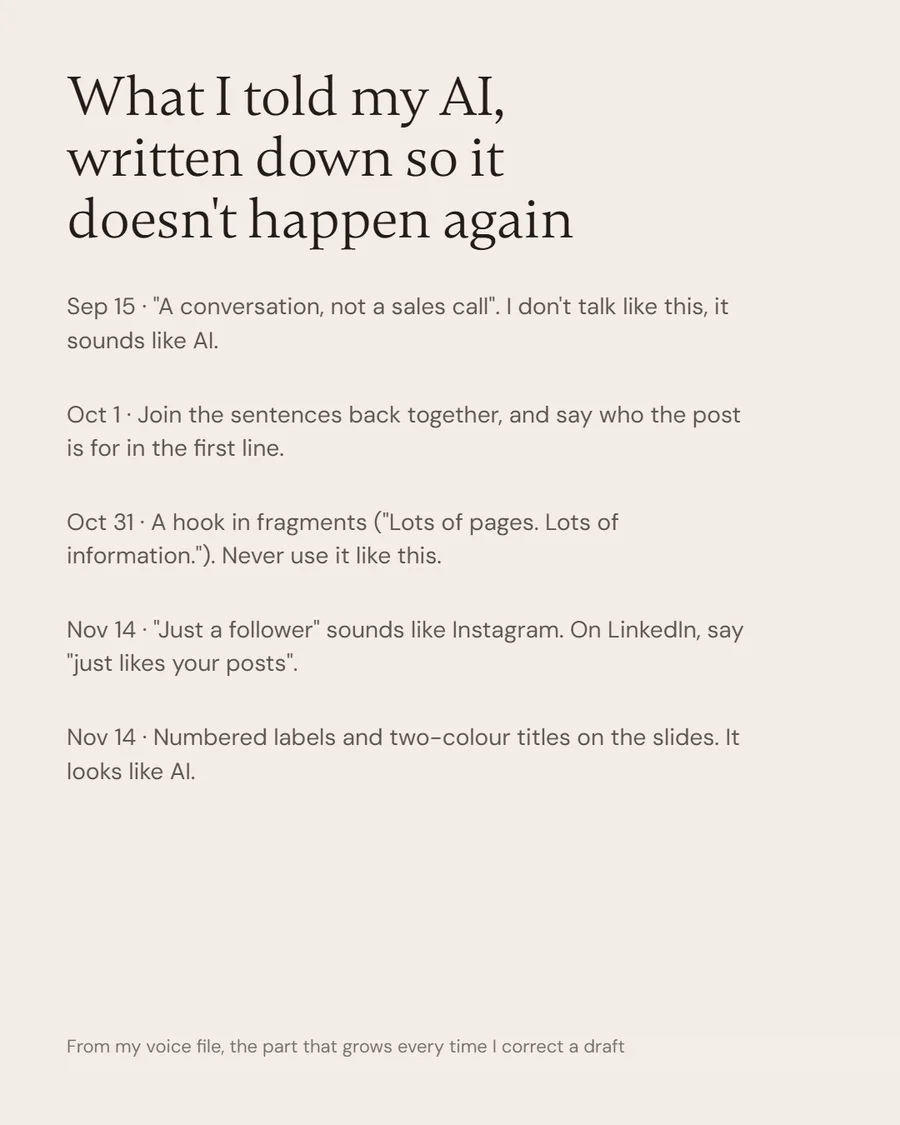
The prompt I type today is usually one line, and the rest is my taste, written down where the AI can read it.
Ok with looking like a beginner
The younger generation growing up with AI might never go through the struggle I went through: stuck for days, studying until late, failing and getting up again. I see creators getting real success because of AI, and I’m happy for them. I’m just not sure it’s all good, because in sensitive work, where a lot can go wrong and the client trusts you with their business, that struggle is where the judgement comes from.

Babies learn a language faster than any of us because they don’t care how they sound. They talk and talk, badly, until one day it sounds right. That’s the feeling I want to keep: being ok with looking like a beginner in front of other people.
The difference between a student and a master is that the master is a student who tried more times. AI doesn’t do the trying for you, it makes each try go further.
If the technical side of your website keeps you up at night, let’s talk.
Tell me what you do and where you are stuck. I will answer myself, and you will have nothing to decide yet.